
RAG part I: Why Your RAG System Keeps Giving Wrong Answers
Table of Contents
Why Your RAG System Keeps Giving Wrong Answers (And It's Not the LLM's Fault)
What is RAG?
RAG (Retrieval-Augmented Generation) is like giving an AI assistant access to your company's filing cabinet. Instead of relying only on what the AI learned during training, it searches through your documents to find relevant information before answering questions.
The Naive RAG Problem
Most companies start with a "naive" RAG implementation: chunk documents into pieces, store them in a vector database, retrieve similar chunks, and send them to the LLM. Sounds simple, right?
Here's the catch: this approach fails in three critical places:
- The Semantic Fracture - When you break documents into fixed-size chunks, you destroy context. A table of contents gets separated from its chapters. Contract clauses lose their amendments. The system can't see the relationships anymore.
- The Precision Gap - Your question gets converted to a single vector and fetches similar-looking chunks. But "similar" doesn't mean "relevant." You ask about an error in production, and you get back documentation about a completely different error that just happens to share keywords.
- The Hallucination Interface - The LLM receives chunks without proper context and starts making things up to fill the gaps. It stitches together information from different sections and confidently presents fiction as fact.
Real Use Cases Where This Breaks
- Contract Management: "What's our termination clause with Vendor X?" returns generic termination language from a different contract.
- Technical Documentation: "How do I fix error 503?" gets docs for error 505 because vectors are similar.
- Compliance Queries: "Show audit requirements for Q4" misses the amendment that changed everything in November.
Naive RAG has 5-45% precision and 30-50% recall. That means half your queries return wrong information. In banking, legal, or compliance scenarios, this isn't just inconvenient. It's dangerous.
The Path Forward
The good news? These problems are solvable with better architecture. But first, you need to recognize that throwing documents into a vector database and hoping for the best isn't a production-ready solution.
In Part II, we'll dive deeper into how to bridge the Semantic Fracture.
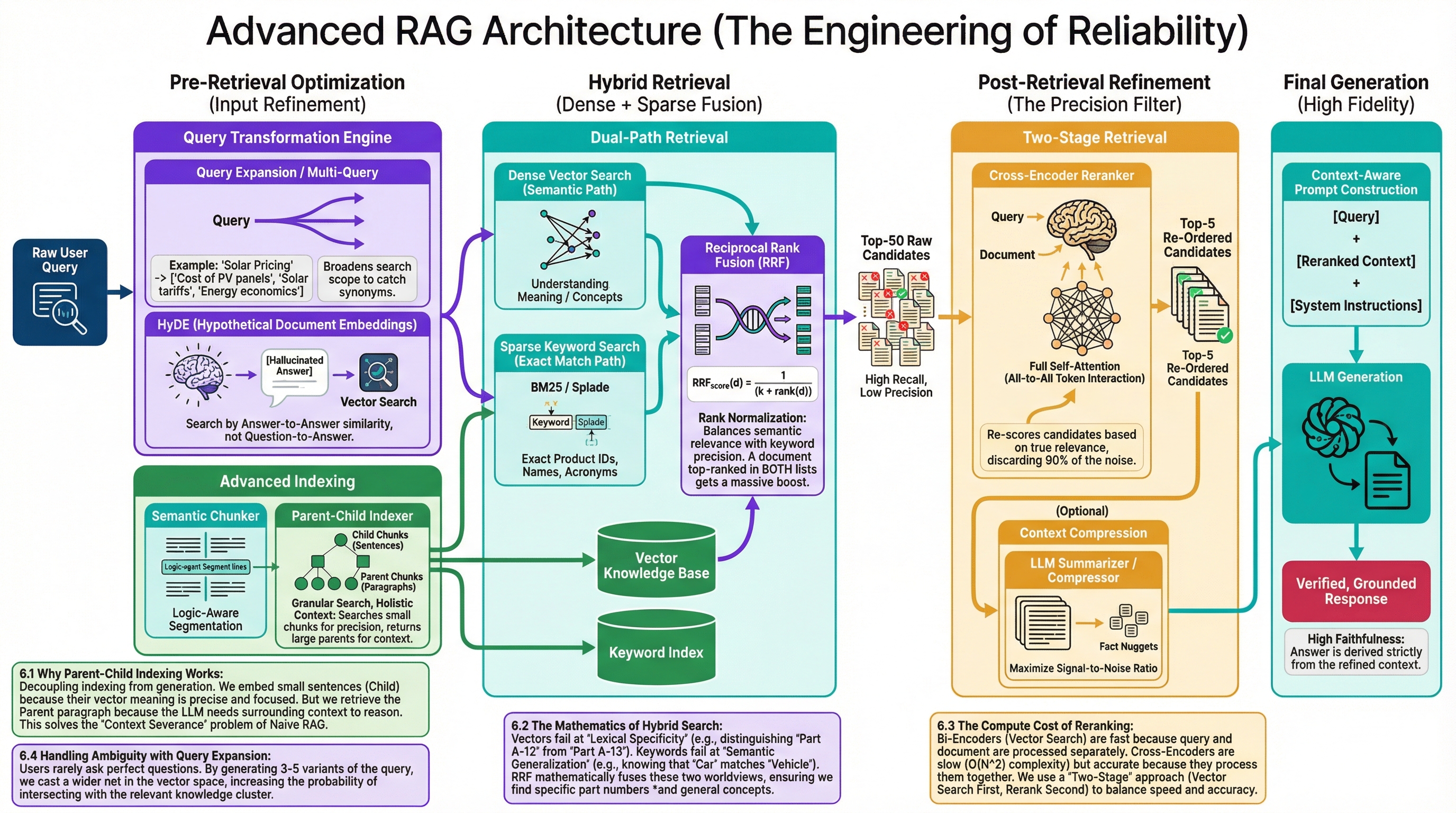
RAG Part II: Why Basic RAG Fails (And How Hybrid RAG Fixes It)
Learn how Hybrid RAG combines vector search with keyword search to solve the reliability problems of naive implementations.